How Fast Can You Really Learn
a Foreign Language?
A Quantitative Study of Language Learning Speed
Author: Pavel Ahafonau, Head of R&D
Most language learners believe progress is slow by nature — that months of effort lead to only modest language understanding. But what if that assumption is wrong?
The graph below visualizes a fundamental shift in how languages can be learned. It is not a projection or a theoretical model, but the result of real user data measured over time. Each point reflects actual learning progress, showing how quickly language understanding level can grow when learning is guided by WRD's unique AI-based method — compared to conventional language learning methods and applications.
This research explores why that difference exists, how large it really is, and what it means for anyone trying to learn a language efficiently.
Graph 1. Language Understanding Progress Over 90 Days by Learning Method
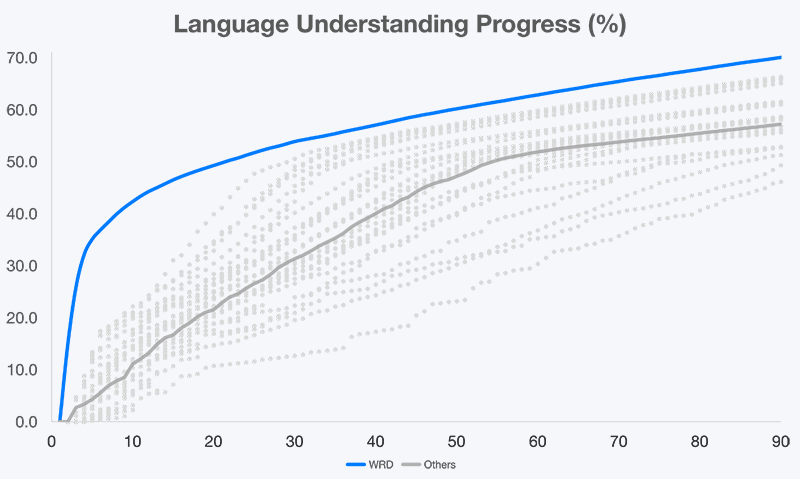
The blue curve in the graph above represents learners using WRD. The grey curve represents the aggregated average of other popular language learning apps.
WRD accelerates learning by continuously selecting what to learn next based on three core principles:
- Real-world language frequency (prioritizing words and idioms that unlock the most understanding)
- Adaptive learning curves that update after every interaction
- Time-efficient reinforcement, ensuring each minute contributes maximum progress
Instead of following a fixed syllabus, WRD recalculates the optimal learning path for each user in real time. The result is faster early gains, sustained progress at intermediate levels, and continued acceleration even for advanced learners — all with minimal daily time investment.
Let's dive in and see how fast learning can really be.
→ Abstract
→ 1. Research Objective
→ 2. Methodology
→ 3. Learning a Language from Zero
→ 4. Learning Beyond the Top 100 Words
→ 5. Learning Beyond the Top 500 Words
→ 6. Learning Beyond the Top 1000 Words
→ 7. Why WRD Is Faster?
→ Conclusion
→ About the Author
Abstract
This research examines how quickly learners can achieve meaningful real-world language understanding when learning is optimized by WRD's unique AI-based approach. Using large-scale user performance data, AI-assisted linguistic modeling, and comparative statistics aggregated from the world's most widely used language learning applications, the study measures learning speed, comprehension growth, and time savings across multiple languages and proficiency levels.
The results show that learners using WRD, over a 90-day period, reach the same levels of real-speech comprehension up to 2.8× faster, saving up to 161 days, while learning in 10 minutes per day or less. The findings demonstrate that language learning speed is not fixed and can be dramatically accelerated through intelligent, data-driven personalization.
1. Research Objective
Language learning has traditionally been viewed as a long-term process requiring years of study and high daily time investment. However, advances in artificial intelligence and large-scale data analysis enable a fundamentally different approach.
The objectives of this research were:
- To measure how fast learners can reach functional real-world language understanding, defined as comprehension of language used in conversations, movies, books, and articles.
- To quantify learning speed improvements for learners who already know the most frequent 100, 500, or 1000 words.
- To compare learning outcomes achieved with WRD against aggregated performance data from leading language learning applications.
Core research question:
How much faster can people realistically learn a foreign language when learning is optimized by WRD's unique AI-based approach, compared to conventional language learning applications and methods?
2. Methodology
Data Collection and Scope
The research is based on a precise, large-scale quantitative analysis conducted by the WRD R&D team. The dataset includes:
- Aggregated, anonymized learning statistics from WRD users
- Aggregated comparative data from the top 10 most downloaded language learning apps
- AI-assisted linguistic frequency analysis across 17 major world languages
Advanced AI models and in-house analytical tools were used to ensure statistical accuracy beyond basic or purely descriptive approaches.
For the sake of cleaner, directly comparable results, the analysis did not factor in several additional optimizations used in WRD that are not available in most other methods and apps. In real-world use, these optimizations make WRD even more efficient than the figures reported.
Learning Assumptions
To ensure consistency and realistic conditions, all learning scenarios assume:
- 10 minutes per day or less
- A learning target of up to 15 new idioms or words per day
- Progress measured as percentage of real-world language understanding, not course completion or grammar coverage
Linguistic Optimization
WRD uses privately curated ranked lists of the most impactful words and idioms for each language. These lists are optimized to maximize comprehension gains per learned unit and are dynamically integrated into WRD's AI-based, continuously evolving personalized learning curve algorithm.
3. Learning a Language from Zero
Results
Learners starting from zero knowledge (0% comprehension) can reach up to 77.5% real-world language understanding in just 90 days, studying less than 10 minutes per day — about 7.5–8 minutes per day with WRD.
Across 17 languages, WRD users consistently achieved:
- 40–60% understanding within 30 days
- 70–78% within 90 days
- 80–90% within 180 days
Compared to the market average:
- Learning speed increased by up to 2.4×
- Time savings reached up to 171 days
Interpretation
These results demonstrate that early-stage language acquisition can be dramatically accelerated when learning sequences are optimized for real-world frequency and reinforced by adaptive AI-driven scheduling.
Table 1. Learning from zero (0% → 77.5% in 90 days)
| Progress Over Time: | 30 Days | 90 Days | 180 Days | |||||||
|---|---|---|---|---|---|---|---|---|---|---|
| Language | Start % | % | Days Saved | Boost | % | Days Saved | Boost | % | Days Saved | Boost |
| English | 0.0 | 54.1 | 35 | 2.2 | 70.1 | 101 | 2.1 | 85.8 | 171 | 2.0 |
| Spanish | 0.0 | 46.0 | 35 | 2.2 | 64.8 | 101 | 2.1 | 84.6 | 171 | 2.0 |
| Portuguese | 0.0 | 54.0 | 35 | 2.2 | 70.0 | 101 | 2.1 | 85.7 | 171 | 2.0 |
| French | 0.0 | 54.8 | 36 | 2.2 | 70.1 | 101 | 2.1 | 84.5 | 171 | 2.0 |
| German | 0.0 | 50.8 | 40 | 2.3 | 68.6 | 107 | 2.2 | 86.7 | 171 | 2.0 |
| Chinese | 0.0 | 53.9 | 36 | 2.2 | 70.0 | 101 | 2.1 | 85.6 | 171 | 2.0 |
| Russian | 0.0 | 45.5 | 43 | 2.4 | 63.5 | 102 | 2.1 | 80.7 | 171 | 2.0 |
| Turkish | 0.0 | 55.0 | 36 | 2.2 | 71.5 | 102 | 2.1 | 85.2 | 171 | 2.0 |
| Italian | 0.0 | 50.6 | 35 | 2.2 | 68.1 | 102 | 2.1 | 86.2 | 171 | 2.0 |
| Japanese | 0.0 | 40.0 | 38 | 2.3 | 61.4 | 104 | 2.2 | 85.1 | 171 | 2.0 |
| Korean | 0.0 | 40.7 | 36 | 2.2 | 59.5 | 102 | 2.1 | 77.7 | 171 | 2.0 |
| Polish | 0.0 | 47.3 | 38 | 2.3 | 64.4 | 102 | 2.1 | 81.5 | 171 | 2.0 |
| Dutch | 0.0 | 54.5 | 42 | 2.4 | 69.9 | 98 | 2.1 | 87.1 | 171 | 2.0 |
| Ukrainian | 0.0 | 47.0 | 37 | 2.2 | 65.2 | 99 | 2.1 | 82.5 | 171 | 2.0 |
| Swedish | 0.0 | 56.9 | 35 | 2.2 | 71.2 | 96 | 2.1 | 85.8 | 168 | 1.9 |
| Norwegian | 0.0 | 54.0 | 40 | 2.3 | 70.0 | 105 | 2.2 | 85.7 | 171 | 2.0 |
| Lithuanian | 0.0 | 59.3 | 36 | 2.2 | 77.5 | 103 | 2.1 | 89.5 | 171 | 2.0 |
4. Learning Beyond the Top 100 Words
Results
Learners starting with knowledge of the top 100 words (~33.9% comprehension on average) reached up to 78.8% understanding in 90 days.
Using WRD:
- Speed improvements reached up to 2.9×
- Learners saved up to 109 days
- The strongest acceleration occurred during the first 30 days
Interpretation
This stage typically represents a plateau for many learners. WRD's adaptive algorithm prevents stagnation by continuously recalculating optimal learning paths based on individual performance data.
Table 2. Improving Understanding after Top 100 words (33.9% → 78.8% in 90 days)
| Progress Over Time: | 30 Days | 90 Days | 180 Days | |||||||
|---|---|---|---|---|---|---|---|---|---|---|
| Language | Start % | % | Days Saved | Boost | % | Days Saved | Boost | % | Days Saved | Boost |
| English | 37.4 | 56.1 | 55 | 2.8 | 71.7 | 108 | 2.2 | 86.3 | 169 | 1.9 |
| Spanish | 28.7 | 47.9 | 51 | 2.7 | 66.2 | 108 | 2.2 | 84.6 | 169 | 1.9 |
| Portuguese | 37.4 | 56.0 | 47 | 2.6 | 71.6 | 107 | 2.2 | 86.2 | 168 | 1.9 |
| French | 40.7 | 57.0 | 46 | 2.5 | 71.5 | 108 | 2.2 | 84.7 | 169 | 1.9 |
| German | 34.9 | 52.7 | 51 | 2.7 | 69.9 | 107 | 2.2 | 86.9 | 169 | 1.9 |
| Chinese | 37.4 | 56.2 | 50 | 2.7 | 71.8 | 108 | 2.2 | 86.5 | 169 | 1.9 |
| Russian | 30.0 | 47.6 | 47 | 2.6 | 64.9 | 107 | 2.2 | 81.0 | 169 | 1.9 |
| Turkish | 34.6 | 57.9 | 52 | 2.7 | 73.4 | 108 | 2.2 | 85.7 | 169 | 1.9 |
| Italian | 34.1 | 52.7 | 47 | 2.6 | 69.5 | 108 | 2.2 | 86.4 | 169 | 1.9 |
| Japanese | 24.7 | 42.3 | 46 | 2.5 | 63.1 | 108 | 2.2 | 85.3 | 169 | 1.9 |
| Korean | 22.4 | 42.9 | 47 | 2.6 | 60.9 | 106 | 2.2 | 78.0 | 169 | 1.9 |
| Polish | 31.6 | 49.1 | 51 | 2.7 | 65.7 | 107 | 2.2 | 81.9 | 169 | 1.9 |
| Dutch | 39.5 | 56.8 | 58 | 2.9 | 71.8 | 109 | 2.2 | 87.4 | 169 | 1.9 |
| Ukrainian | 30.0 | 49.2 | 47 | 2.6 | 66.7 | 107 | 2.2 | 82.9 | 169 | 1.9 |
| Swedish | 41.3 | 59.3 | 55 | 2.8 | 73.0 | 108 | 2.2 | 86.8 | 169 | 1.9 |
| Norwegian | 37.4 | 56.1 | 48 | 2.6 | 71.6 | 108 | 2.2 | 86.3 | 169 | 1.9 |
| Lithuanian | 35.5 | 62.0 | 53 | 2.8 | 78.8 | 108 | 2.2 | 89.9 | 169 | 1.9 |
5. Learning Beyond the Top 500 Words
Results
Learners starting at approximately 49.0% comprehension reached up to 82.0% understanding in 90 days.
WRD enabled:
- Learning speeds up to 2.7× faster
- Time savings of up to 138 days
- Rapid progression from intermediate to advanced comprehension levels
Interpretation
At intermediate stages, efficiency per minute becomes critical. WRD minimizes repeated exposure to material learners already know and focuses on high-impact linguistic gaps, resulting in sustained acceleration.
Table 3. Improving Understanding after Top 500 words (49.0% → 82.0% in 90 days)
| Progress Over Time: | 30 Days | 90 Days | 180 Days | |||||||
|---|---|---|---|---|---|---|---|---|---|---|
| Language | Start % | % | Days Saved | Boost | % | Days Saved | Boost | % | Days Saved | Boost |
| English | 52.3 | 62.2 | 46 | 2.5 | 75.9 | 134 | 2.5 | 86.6 | 157 | 1.9 |
| Spanish | 44.0 | 54.9 | 45 | 2.5 | 71.4 | 135 | 2.5 | 84.9 | 159 | 1.9 |
| Portuguese | 52.3 | 62.3 | 46 | 2.5 | 75.9 | 135 | 2.5 | 86.6 | 158 | 1.9 |
| French | 53.2 | 62.7 | 49 | 2.6 | 75.3 | 137 | 2.5 | 85.1 | 160 | 1.9 |
| German | 48.9 | 59.3 | 49 | 2.6 | 74.8 | 136 | 2.5 | 87.2 | 160 | 1.9 |
| Chinese | 52.3 | 62.1 | 46 | 2.5 | 75.9 | 134 | 2.5 | 86.6 | 159 | 1.9 |
| Russian | 43.5 | 54.2 | 48 | 2.6 | 69.4 | 138 | 2.5 | 81.1 | 160 | 1.9 |
| Turkish | 53.4 | 64.5 | 47 | 2.6 | 77.2 | 134 | 2.5 | 86.0 | 157 | 1.9 |
| Italian | 48.7 | 59.2 | 45 | 2.5 | 74.2 | 135 | 2.5 | 86.6 | 159 | 1.9 |
| Japanese | 37.8 | 49.9 | 47 | 2.6 | 69.1 | 136 | 2.5 | 85.4 | 160 | 1.9 |
| Korean | 38.6 | 50.0 | 47 | 2.6 | 65.9 | 134 | 2.5 | 78.4 | 157 | 1.9 |
| Polish | 45.3 | 55.2 | 47 | 2.6 | 70.1 | 138 | 2.5 | 81.8 | 160 | 1.9 |
| Dutch | 53.3 | 62.3 | 49 | 2.6 | 76.1 | 136 | 2.5 | 87.5 | 160 | 1.9 |
| Ukrainian | 45.0 | 55.7 | 48 | 2.6 | 71.1 | 137 | 2.5 | 82.9 | 160 | 1.9 |
| Swedish | 55.8 | 64.5 | 47 | 2.6 | 76.8 | 137 | 2.5 | 86.9 | 160 | 1.9 |
| Norwegian | 52.3 | 62.2 | 44 | 2.5 | 75.9 | 134 | 2.5 | 86.6 | 158 | 1.9 |
| Lithuanian | 56.7 | 68.8 | 51 | 2.7 | 82.0 | 134 | 2.5 | 89.7 | 160 | 1.9 |
6. Learning Beyond the Top 1000 Words
Results
Advanced learners starting at 57.8% comprehension on average reached up to 86.0% understanding in 90 days.
With WRD:
- Learning speed increased up to 3.0×
- Time savings reached up to 161 days
- Near-fluency comprehension was achieved in under six months
Interpretation
The data shows that learning speed does not necessarily decrease at higher proficiency levels when AI-based personalization remains active and adaptive.
Table 4. Improving Understanding after Top 1000 words (57.8% → 86.0% in 90 days)
| Progress Over Time: | 30 Days | 90 Days | 180 Days | |||||||
|---|---|---|---|---|---|---|---|---|---|---|
| Language | Start % | % | Days Saved | Boost | % | Days Saved | Boost | % | Days Saved | Boost |
| English | 60.5 | 68.3 | 59 | 3.0 | 80.8 | 161 | 2.8 | 86.6 | 148 | 1.8 |
| Spanish | 53.3 | 62.3 | 57 | 2.9 | 77.5 | 157 | 2.7 | 85.0 | 149 | 1.8 |
| Portuguese | 60.5 | 68.4 | 55 | 2.8 | 80.8 | 155 | 2.7 | 86.6 | 148 | 1.8 |
| French | 61.1 | 68.4 | 59 | 3.0 | 79.7 | 161 | 2.8 | 85.0 | 149 | 1.8 |
| German | 57.8 | 66.0 | 56 | 2.9 | 80.2 | 157 | 2.7 | 87.1 | 150 | 1.8 |
| Chinese | 60.5 | 68.4 | 53 | 2.8 | 80.8 | 152 | 2.7 | 86.6 | 147 | 1.8 |
| Russian | 52.7 | 61.0 | 56 | 2.9 | 74.7 | 156 | 2.7 | 81.0 | 150 | 1.8 |
| Turkish | 62.5 | 70.1 | 52 | 2.7 | 81.0 | 149 | 2.7 | 85.7 | 147 | 1.8 |
| Italian | 57.5 | 65.8 | 60 | 3.0 | 79.7 | 159 | 2.8 | 86.6 | 150 | 1.8 |
| Japanese | 48.2 | 58.2 | 59 | 3.0 | 76.3 | 157 | 2.7 | 85.5 | 150 | 1.8 |
| Korean | 48.1 | 57.0 | 57 | 2.9 | 71.4 | 154 | 2.7 | 78.2 | 148 | 1.8 |
| Polish | 53.9 | 62.0 | 56 | 2.9 | 75.5 | 156 | 2.7 | 81.9 | 150 | 1.8 |
| Dutch | 60.8 | 68.1 | 53 | 2.8 | 81.0 | 153 | 2.7 | 87.3 | 149 | 1.8 |
| Ukrainian | 54.2 | 62.9 | 56 | 2.9 | 76.5 | 152 | 2.7 | 82.9 | 150 | 1.8 |
| Swedish | 63.2 | 69.9 | 58 | 2.9 | 81.2 | 158 | 2.8 | 86.8 | 150 | 1.8 |
| Norwegian | 60.5 | 68.3 | 53 | 2.8 | 80.8 | 154 | 2.7 | 86.6 | 145 | 1.8 |
| Lithuanian | 67.5 | 75.5 | 56 | 2.9 | 86.0 | 157 | 2.7 | 90.0 | 147 | 1.8 |
7. Why WRD Is Faster?
The acceleration observed across all scenarios is not the result of increased study time, but of higher learning efficiency per minute.
WRD's unique AI-based approach combines:
- High-impact linguistic prioritization
- Personalized learning curves that adapt in real time
- Continuous recalibration based on user performance
- Focus on real-world language usage rather than academic ordering
This approach systematically removes wasted effort from the learning process.
Conclusion
This research demonstrates a clear and consistent conclusion across languages and starting levels:
Language learning speed is not fixed. When optimized by WRD's unique AI-based approach, it can be accelerated by a factor of two to three.
Learners using WRD:
- Reach meaningful real-world comprehension months earlier
- Save up to half a year of learning time
- Achieve results with less than 10 minutes per day
WRD establishes a new efficiency benchmark for language learning — transforming language mastery from a long-term commitment into a realistic, data-driven process.
About the Author
Pavel Ahafonau is Head of R&D at WRD. His work focuses on AI-driven learning optimization, large-scale linguistic modeling, and personalized systems designed to maximize human learning efficiency.