How Many Words
Do You Really Need to
Understand a Language?
A Data-Driven Analysis of Language Understanding by Idiom Frequency
Author: Pavel Ahafonau, Head of R&D
What does knowing the top 100, 500, and 1000 idioms actually get you?
Many learners track progress by counting words learned, yet this number rarely reflects how much real language they can actually understand. When comprehension is measured directly and linked to idiom knowledge, learning progress becomes visible in a much more concrete way. The graph below shows how language understanding evolves as learners move from a small core of high-impact idioms toward broader coverage.
Graph 1. Language Understanding Progress by Number of Idioms Learned
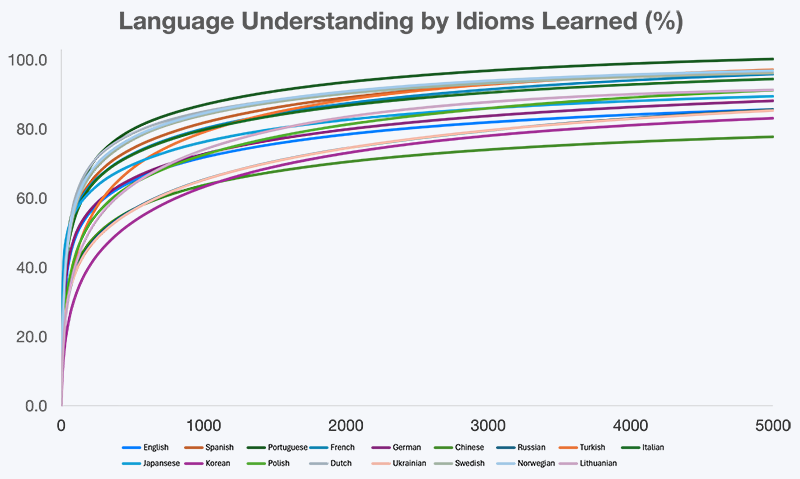
Language understanding does not increase at a constant rate. As the graph illustrates, comprehension grows rapidly when learners acquire the most frequently used idioms, then gradually slows as learning shifts from unlocking core meaning to refining nuance. This pattern raises a practical question: how many idioms are enough to reach meaningful real-world understanding — and where additional effort begins to yield diminishing returns?
This relationship can also be measured at the individual level. By tracking idiom acquisition and mapping it to real-world usage frequency, WRD estimates a learner's current level of language understanding continuously, updating it with each newly learned idiom.
Dive in to explore the data, methodology, and findings:
→ Abstract
→ 1. Introduction
→ 2. Data Sources and Scale
→ 3. Idiom-Centered Methodology
→ 4. Measuring Language Understanding
→ 5. Results
→ 6. Why Idioms Unlock Understanding Faster
→ 7. Implications for Language Learning
→ Conclusion
→ About the Author
Abstract
A common belief in language learning is that understanding a language requires memorizing tens of thousands of words. This study challenges that assumption by analyzing how language understanding scales with the number of high-frequency idioms learned, rather than raw vocabulary size. Using large-scale linguistic data derived from real-world language usage, we quantify what learners actually gain by mastering the top 100, 500, and 1000 idioms — and demonstrate why idioms, not isolated words, are the primary drivers of real comprehension.
1. Introduction
Language is not used as a collection of isolated words. In everyday conversations, books, films, articles, and encyclopedic texts, meaning is conveyed through stable expressions, grammatical constructions, and idiomatic patterns. Traditional vocabulary-based learning approaches often fail to translate into real understanding because they overlook how language is actually used.
This research addresses a fundamental question:
How much of a language can a learner realistically understand by mastering its most important idioms?
2. Data Sources and Scale
The study is based on an extensive large-scale analysis of real-world language usage, drawing from conversational language, movies and subtitles, books, articles, encyclopedic and educational texts, as well as aggregated open datasets from publicly available corpus resources and vocabularies linking idioms and words across languages. In total, the analysis covered large-scale multilingual corpora comprising billions of words, sourced from the web and published materials, representing a substantial portion of the language people encounter and use in everyday communication.
3. Idiom-Centered Methodology
3.1 From Words to Idioms
Rather than counting surface-level word forms, this study treats idioms as the primary unit of meaning. An idiom here includes not only fixed expressions but also grammatical base forms that represent multiple word variants.
Using a set of advanced language models, we:
- Merged all grammatical word forms into their base idiom (e.g., “am,” “is,” “are,” “was” → “be”)
- Treated word forms as separate idioms only when they carried distinct idiomatic meanings within a language
This normalization enabled:
- Accurate frequency measurement
- Cross-language comparability
- Elimination of artificial vocabulary inflation
The result was a precise mapping between actual usage frequency and core semantic units.
4. Measuring Language Understanding
Language understanding was defined as the percentage of real-world content a learner can comprehend without external assistance. This includes the ability to:
- Follow spoken conversations
- Understand written texts
- Consume media without constant lookup
- Grasp implied meaning, structure, and context
Understanding levels were measured after acquiring:
- Top 100 idioms
- Top 500 idioms
- Top 1000 idioms
- Extended ranges of 3000–5000 idioms for advanced analysis
Building on this research, WRD applies the same measurement principles at the individual learner level. As users learn new idioms, language understanding is recalculated incrementally, allowing comprehension to be tracked with high precision rather than inferred indirectly from vocabulary size. This approach reflects real-world usage patterns observed in the data and enables continuous, fine-grained measurement of progress.
5. Results
5.1. Language Understanding by Idiom Vocabulary Size
The summarized results of the study across 17 languages are presented in the table below, showing estimated real-world language understanding as idiom knowledge increases.
Table 1. Summary of Language Understanding (%) Based on Top Idioms Learned
| Language | Understanding (%) by Idiom Vocabulary Threshold | ||||
|---|---|---|---|---|---|
| Top 100 | Top 500 | Top 1000 | Top 3000 | Top 5000 | |
| English | 48.8 | 64.9 | 71.8 | 81.9 | 85.6 |
| Spanish | 49.6 | 66.3 | 73.5 | 84.1 | 87.5 |
| Portuguese | 58.8 | 78.2 | 85.0 | 94.3 | 97.2 |
| French | 52.7 | 68.1 | 75.2 | 86.0 | 89.6 |
| German | 47.8 | 63.3 | 70.1 | 80.5 | 84.0 |
| Chinese | 40.3 | 56.7 | 63.7 | 74.0 | 77.8 |
| Russian | 38.7 | 56.5 | 65.0 | 79.1 | 85.0 |
| Turkish | 42.9 | 68.6 | 79.1 | 92.9 | 97.1 |
| Italian | 47.6 | 64.3 | 71.2 | 81.5 | 84.7 |
| Japanese | 56.5 | 69.7 | 76.3 | 86.0 | 89.5 |
| Korean | 31.9 | 53.0 | 63.2 | 78.0 | 83.1 |
| Polish | 43.1 | 62.8 | 71.1 | 84.1 | 88.4 |
| Dutch | 57.3 | 74.7 | 80.7 | 88.6 | 91.0 |
| Ukrainian | 36.9 | 54.4 | 63.2 | 77.4 | 83.0 |
| Swedish | 52.9 | 71.4 | 78.1 | 86.5 | 88.9 |
| Norwegian | 52.8 | 70.7 | 77.4 | 86.2 | 88.6 |
| Lithuanian | 38.2 | 60.5 | 70.3 | 83.5 | 86.6 |
While the exact percentages vary by language, the overall pattern is consistent: a relatively small set of high-frequency idioms accounts for a large share of real-world understanding. To make these results practical, the following sections provide language-specific lists of the most frequent words and idioms, starting with the top 100 for each language analyzed in this study.
Top Idiom Lists to Learn by Language
→ English → Spanish → Portuguese → French → German → Chinese → Russian → Turkish → Italian → Japanese → Korean → Polish → Dutch → Ukrainian → Swedish → Norwegian → Lithuanian
5.2. Interpretation of Results
Several consistent patterns emerge:
- Strong early gains: The first 500 idioms unlock a large portion of everyday language, often reaching 55–75% understanding.
- Functional comprehension at 1000 idioms: Around 1000 idioms, learners can comfortably follow conversations, read simplified native texts, and consume media with minimal support.
- Advanced understanding by 3000 idioms: The 3000-idiom range corresponds to high functional fluency, frequently exceeding 80–90% comprehension.
- Diminishing returns beyond 5000 idioms: Additional idioms primarily add stylistic nuance rather than unlocking new content.
5.3. Cross-Language Consistency
Despite differences in grammar, writing systems, and cultural structure, the shape of the comprehension curve remains remarkably similar across all 17 languages. This indicates a universal property of language usage: meaning is concentrated in a relatively small set of high-frequency idiomatic patterns.
6. Why Idioms Unlock Understanding Faster
Idioms act as semantic compression units. Each idiom encapsulates:
- Multiple words
- Grammatical structure
- Cultural and contextual meaning
Recognizing an idiom allows the brain to process meaning instantly rather than reconstructing it word by word, reducing cognitive load and accelerating comprehension in both reading and listening.
7. Implications for Language Learning
The findings have direct consequences for learners, educators, and language-learning product design:
- Prioritize high-frequency idioms early
- Measure progress by understanding %, not vocabulary size
- Optimize learning for real usage, not theoretical completeness
Idioms are not advanced material — they are foundational to real comprehension.
Conclusion
You do not need to know tens of thousands of words to understand a language. You need to know how the language is actually used.
By focusing on the most important idioms, learners unlock a disproportionate share of meaning early, achieving faster comprehension, greater confidence, and earlier access to authentic content. Language understanding grows not through accumulation, but through prioritization.
About the Author
Pavel Ahafonau is Head of R&D at WRD. His work focuses on AI-driven learning optimization, large-scale linguistic modeling, and personalized systems designed to maximize human learning efficiency.